
AI EXPLORATION
OIL & GAS
AI ENHANCED RESEARCH
VIBE CODING
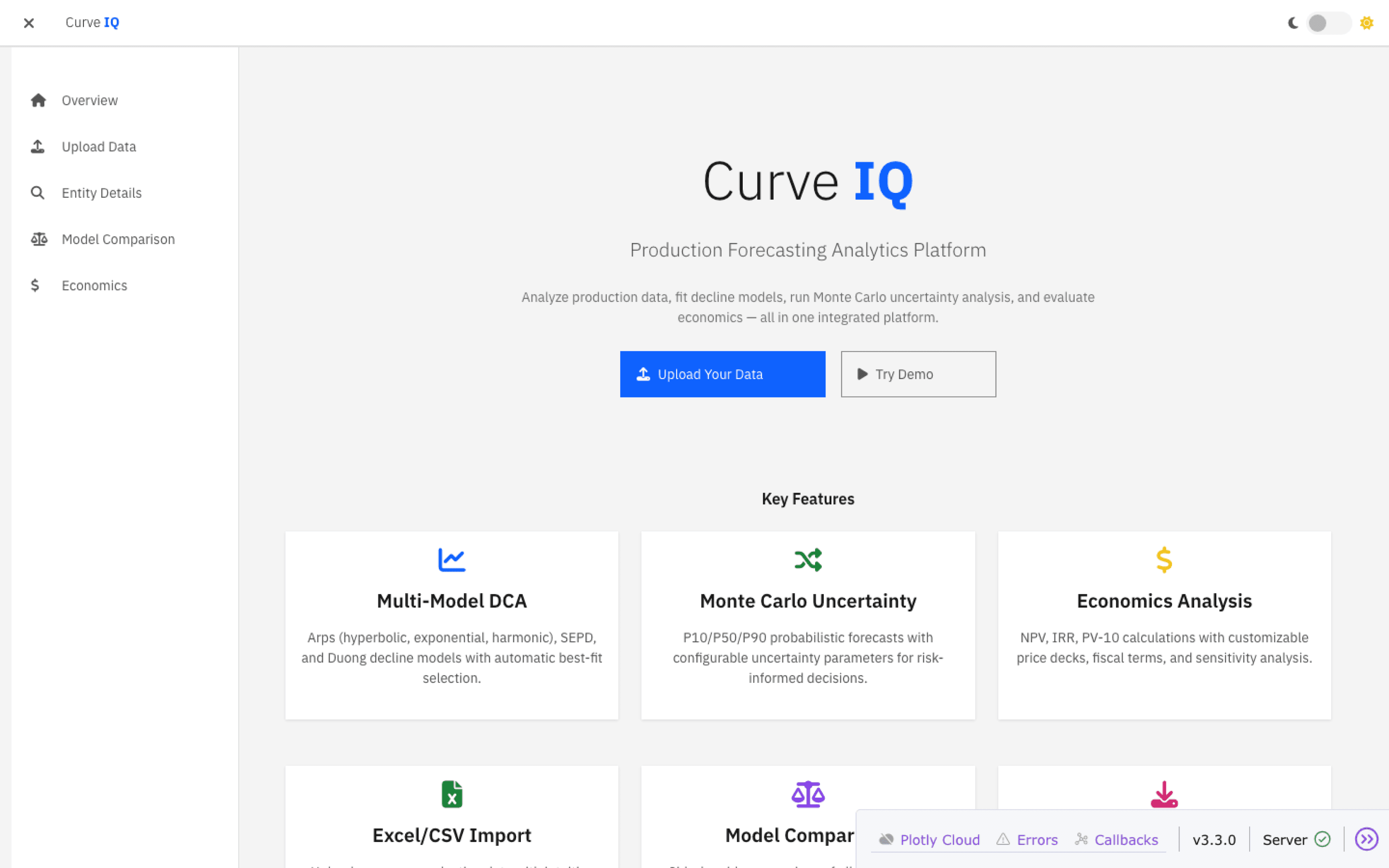
Curve IQ
Transforming 3-week petroleum engineering workflows into same-day decisions
85%
Time Reduction
15-20 hrs → 2-3 hrs
$1.2M
Annual Value
Per engineering team
5×
Faster Decisions
Weeks to hours
80%
Feature Adoption
vs 20% in legacy tools

Photo by Zbynek Burival on Unsplash
The Problem
The 3-Week Forecast
It's Tuesday morning in Houston. David, a senior reservoir engineer, just
received an urgent request:
"We need EUR forecasts and economics
for the Permian acquisition target by Friday."
David opens ARIES, the industry-standard software. His heart sinks. He
knows what's coming: hours of exporting data, cleaning in Excel,
fighting import errors, manually tweaking curve parameters, exporting to
PHDwin for economics, then rebuilding ugly charts in PowerPoint.
This analysis will take 15-20 hours spread over 2-3 weeks. The
acquisition opportunity might be gone by then.
Overview
Reimagining Decline Curve Analysis
Curve IQ is an AI-enhanced web platform that automates the tedious manual
processes consuming 60-70% of petroleum engineers' time, while maintaining
explainability and control for multi-million dollar decisions.
The Challenge
Engineers spend 60-70% of workflow time on
manual data wrangling. Legacy tools like ARIES
are powerful but suffer from poor usability and
lack of AI automation.
My Role
UX Designer & Researcher leading end-to-end
design: secondary research, persona
development, journey mapping, AI integration
strategy, UI design with IBM Carbon, and
functional prototype.
The Solution
A unified web platform with AI-powered data
cleaning, automated curve fitting with
explainable recommendations, integrated
economics, and instant scenario generation.
The $60K Problem
Senior reservoir engineers earn ~$150K annually. With 40% of their time wasted on manual data work, that's $60K per engineer per year
spent on zero-value tasks. For an 8-person team, that's nearly $500K annually in productivity loss.
60-70%
Time on manual work
20%
Feature utilization
2-3 wks
Analysis cycle
$50K+
Per ARIES seat/yr
Research & Discovery
Evidence-Based Problem Definition
Comprehensive secondary research across industry forums, software reviews, and
academic publications—synthesizing 50+ sources to build an evidence-based
foundation.
Community Research
Analyzed 50+ discussions from Reddit
r/petroleum_engineers, SPE Connect forums, and
LinkedIn groups.
"I spend more time cleaning data than analyzing
it."
Software Reviews
Studied G2, Capterra reviews for ARIES, PHDwin,
OFM, ComboCurve to identify consistent pain
points.
"Only touching 20% of what the software can
do."
Industry Publications
Reviewed technical papers from OnePetro, JPT,
and Hart Energy on DCA methodologies and AI
applications.
"Data reliability is the most significant
challenge" — 85% of sources
Research Insights
5 Critical Pain Points
Synthesized from 50+ industry sources including Reddit, SPE forums, and software reviews
⏰
6-8 Hours on Data Prep
Manual cleaning, shut-in removal, outlier
detection, format preparation. Zero value-add
work.
🔄
Cross-Platform Chaos
Juggling ARIES, PHDwin, Excel, and PI
System. Constant export/import cycles and
format errors.
️
Legacy UI Nightmare
Users only access 20% of features. Cryptic
errors, buried settings, steep learning curve.
📈
Trial-and-Error Fitting
1-2 hours adjusting parameters until "it looks
good." No statistical validation.
🤖
"Black Box" AI Fear
"Management won't accept forecasts I can't
explain." SEC auditors need defensible
methodology.
📊
Report Rebuilding
Screenshot charts, paste into PowerPoint,
format manually. 2+ hours for presentation-
ready output.
Competitive Landscape
Legacy Tools vs. Modern Needs
Industry-standard tools haven't kept pace with modern UX expectations
Halliburton ARIES
Industry Standard • $50K+/seat/year
Usability
Features
✕
Dated interface from 1990s
✕
Cryptic error messages
✕
Complex import process
✕
No AI automation
Peloton PHDwin
Economics Focus • Desktop Only
Usability
Features
✕
Separate from DCA tools
✕
Manual data transfer
✕
Steep learning curve
✕
Windows-only
ComboCurve
Modern Entrant • Cloud-Based
Usability
Features
✕
Limited DCA models
✕
Basic curve fitting
✕
No AI recommendations
✕
No uncertainty analysis
The Market Gap
Legacy tools have powerful features but terrible UX. Modern tools have better UX but limited
functionality.
No solution combines AI automation, explainability, and enterprise-grade features.
Primary User
Meet Rick Chen
Senior Reservoir Engineer, 12 Years Experience
Photo by LinkedIn Sales

"I became a reservoir engineer to solve complex subsurface puzzles, not to
spend 70% of my time fighting with data formatting and clunky software
interfaces."
Background
38 years old, MS Petroleum Engineering, Texas A&M.
Managing 150+ wells across Permian Basin.
Goals
Complete DCA in 2-3 hours, not 15-20. Spend 60%+
time on strategic analysis. Get promoted to Staff
Engineer.
Frustrations
Manual preprocessing, cross-platform chaos, cryptic
errors, no confidence intervals on forecasts.
AI Attitude
"AI should be my copilot, not my replacement.
Automate the tedious stuff so I can focus on the
interesting puzzles."
Workflow Transformation
Before & After
Current: ARIES Workflow
1
Locate data in PI System
1-2 hours
2
Export & review in Excel
1 hour
3
Manual data cleaning
3-4 hours
4
Format for ARIES import
1-2 hours
5
Import & debug errors
1 hour
6
Manual curve fitting
1-2 hours
7
Export to PHDwin for economics
2-3 hours
8
Rebuild charts in PowerPoint
2 hours
15-20 hrs
Over 2-3 weeks
→
Future: Curve IQ Workflow
1
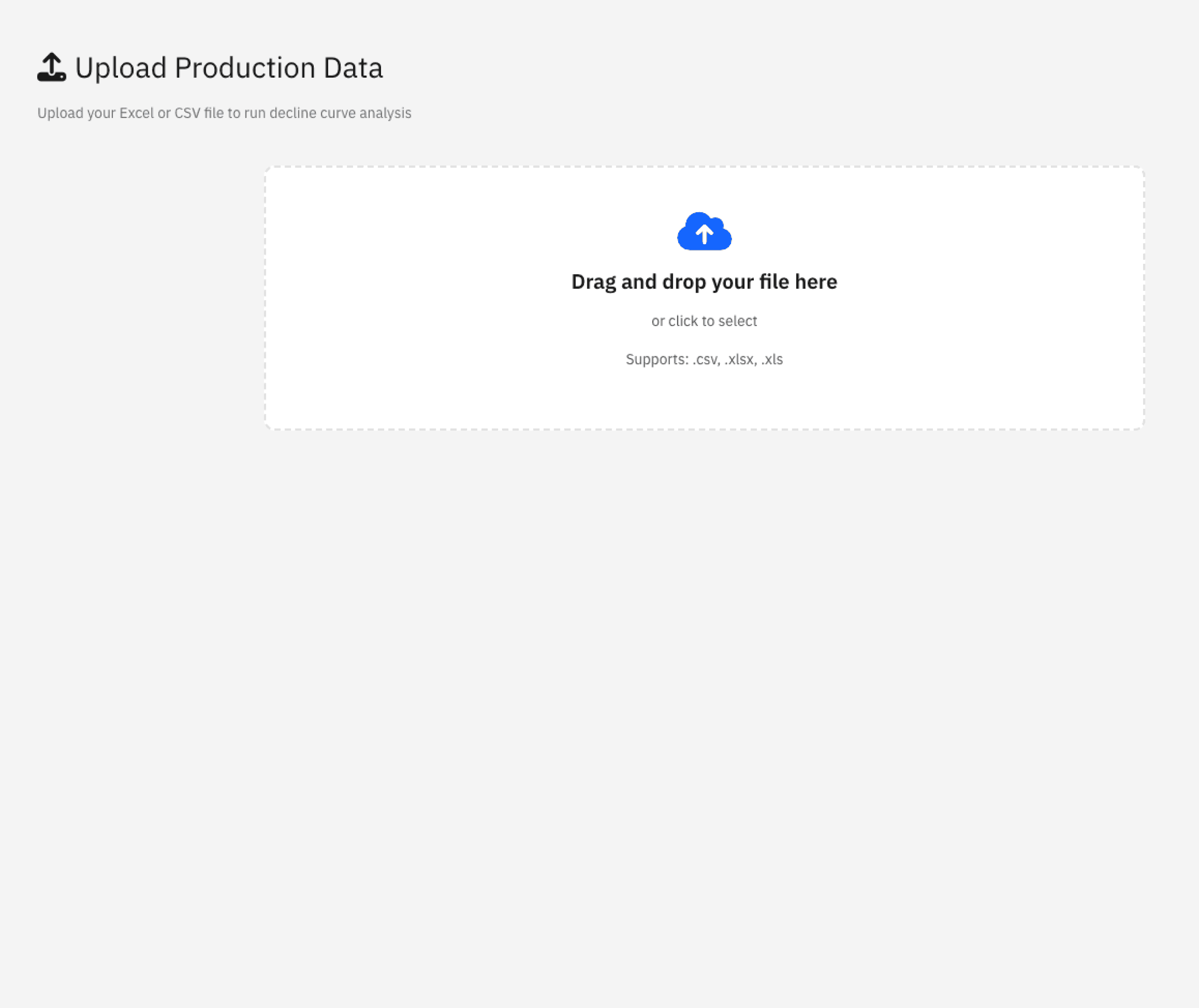
Drag & drop data upload
5 minutes
2
AI data cleaning (explained)
10 minutes
3
Review & approve changes
15 minutes
4
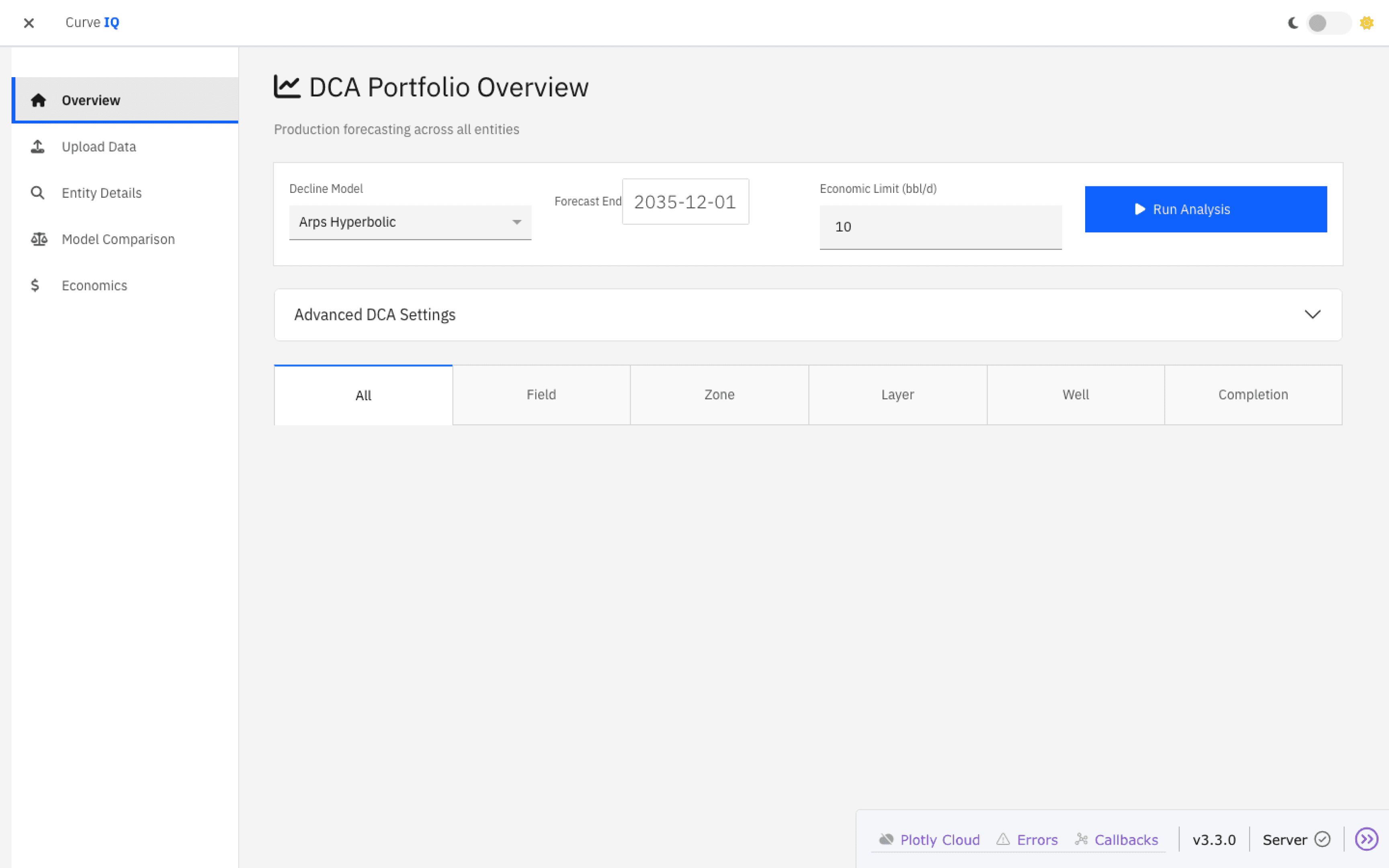
AI curve fitting (all models)
30 seconds
5
Validate with R², RMSE, CI
30 minutes
6
Monte Carlo scenarios
5 minutes
7
Integrated economics (NPV, IRR)
15 minutes
8
Export reports & charts
5 minutes
2-3 hrs
Same day
Design Solutions
From Problem to Solution
Each solution directly addresses a validated pain point, using AI automation where it
delivers highest impact while maintaining engineer control.


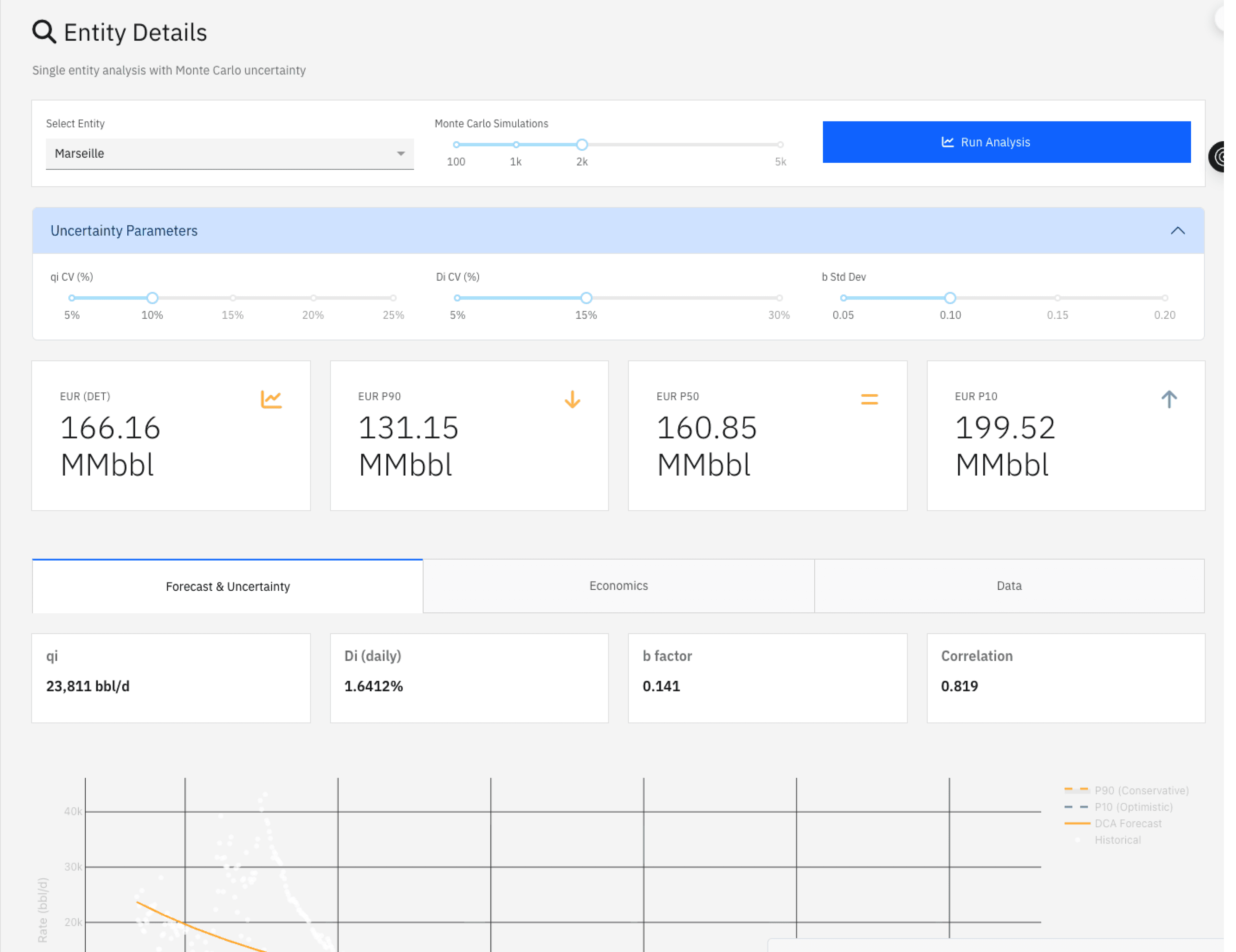
Design System
IBM Carbon Implementation
Enterprise-grade design with WCAG AA accessibility and theme support for 24/7
operations
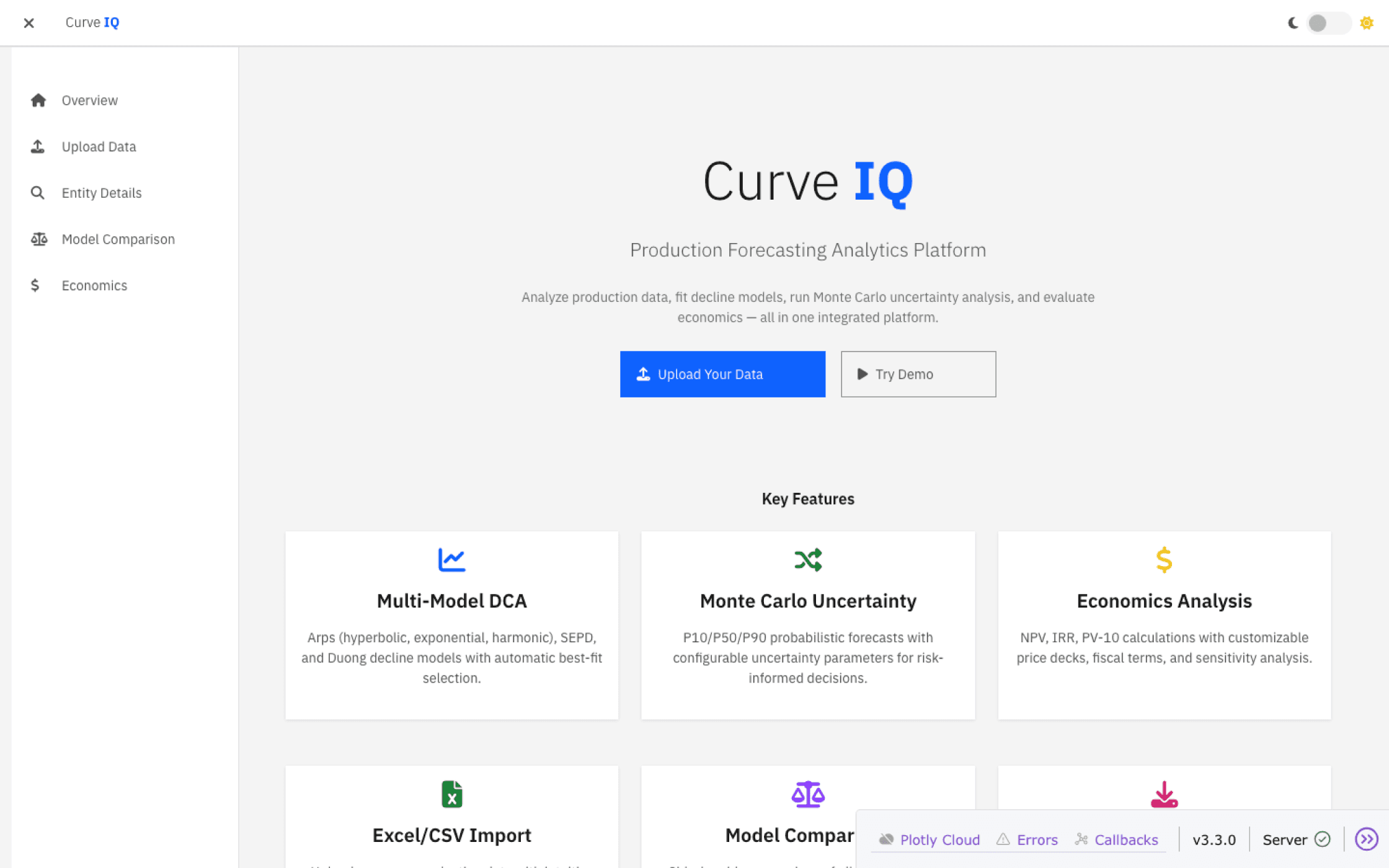
Light Theme (Gray 10)
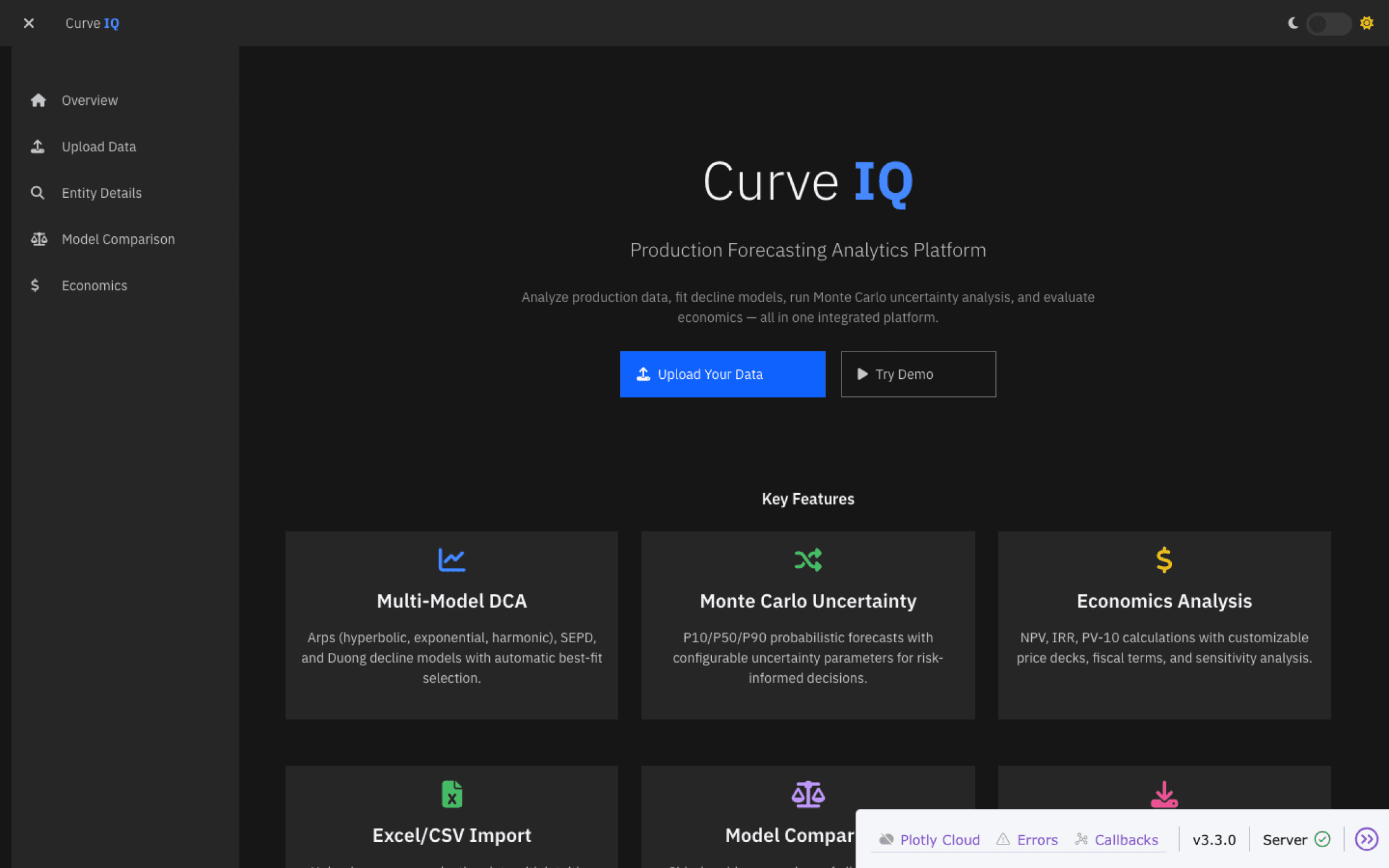
Dark Theme (Gray 100)
🎨
IBM Plex Sans
Clean typography for data-heavy interfaces
♿
WCAG AA Compliant
13.5:1 primary text contrast ratio
🌙
Theme Switching
Dark mode for control rooms & night shifts
Color System
Dark Theme (Gray 100)
Backgrounds
Background
#161616
Surface
#262626
Card
#393939
Text
Primary
#f4f4f4
Secondary
#c6c6c6
Link
#78a9ff
Interactive & Status
Primary
#4589ff
Success
#42be65
Warning
#f1c21b
Error
#ff8389
Light Theme (Gray 10)
Backgrounds
Background
#f4f4f4
Surface
#ffffff
Hover
#e0e0e0
Text
Primary
#161616
Secondary
#525252
Link
#0f62fe
Interactive & Status
Primary
#0f62fe
Success
#198038
Warning
#f1c21b
Error
#da1e28
WCAG AA Compliant — All text colors meet minimum 4.5:1 contrast ratio. Primary text achieves AAA (13.5:1 dark, 12.6:1 light).
Reflections
Key Learnings
🔍
AI Needs Explainability
The biggest barrier isn't capability—it's trust. "Black box" AI
won't be adopted in engineering workflows where auditors
demand defensible methodology.
⚡
Domain Expertise Accelerates Research
My 1.5 years of oil & gas UX experience helped quickly validate
findings and avoid common pitfalls in enterprise software design.
🎯
Legacy Problems = Design Opportunities
80% feature underutilization isn't a training problem—it's a
design failure. Modern UX can unlock capabilities hidden for
years.
️

Prototyping Validates Feasibility
Building a functional Python/Dash prototype proved the design
was technically achievable, not just conceptually appealing.
Transforming How Engineers Work
Curve IQ demonstrates how thoughtful design combined with AI
automation can transform workflows that have remained frustratingly
manual for decades.
Stack
Python • Dash • Plotly • SciPy
Design System
IBM Carbon